Durable and Cheap Slatted Fence Panels for Garden Security
Finding a balance between security and budget often leads property owners to explore economical perimeter solutions. While many search for cheap slatted fence panels to achieve privacy, the real value lies in selecting a material that resists environmental degradation without requiring constant maintenance. In the metal fabrication industry, chain-link systems with specialized coatings have emerged as a superior alternative to traditional wooden slats, offering a modular approach to boundary management.
For residential gardens, sports fields, or industrial zones, the priority is usually a combination of visibility control and structural integrity. By utilizing low-carbon steel wire with PVC or hot-dipped galvanized finishes, manufacturers can provide a high-strength barrier that mimics the functional benefits of slatted designs while significantly reducing installation time and long-term replacement costs.

Analyzing Material Composition for Long-Term Outdoor Durability
The longevity of any boundary system depends entirely on its reaction to moisture and oxidation. In metal wire manufacturing, the choice between PVC coating and hot-dipped galvanization defines the product's lifecycle. Hot-dipped galvanizing creates a metallurgical bond between the zinc and the steel, providing a sacrificial layer that protects the inner core from rust, which is essential for humid or coastal environments.
For those seeking a more aesthetic appeal, PVC powder coating offers an additional layer of protection while allowing for color customization. Common industry standards such as Green RAL6005, Grey RAL7016, and Black RAL9005 are frequently used to blend the fence into natural landscapes or urban architectures. This dual-layer approach—galvanized steel topped with PVC—ensures that the barrier remains structurally sound even under heavy exposure to UV radiation and rain.
- Low Carbon Steel: Provides the necessary flexibility and strength for tensioning.
- PVC Coating: Enhances corrosion resistance and offers a smooth, humane finish.
- Hot-Dipped Galvanized: The industry benchmark for industrial-grade rust prevention.

Technical Installation Logic and Structural Support Systems
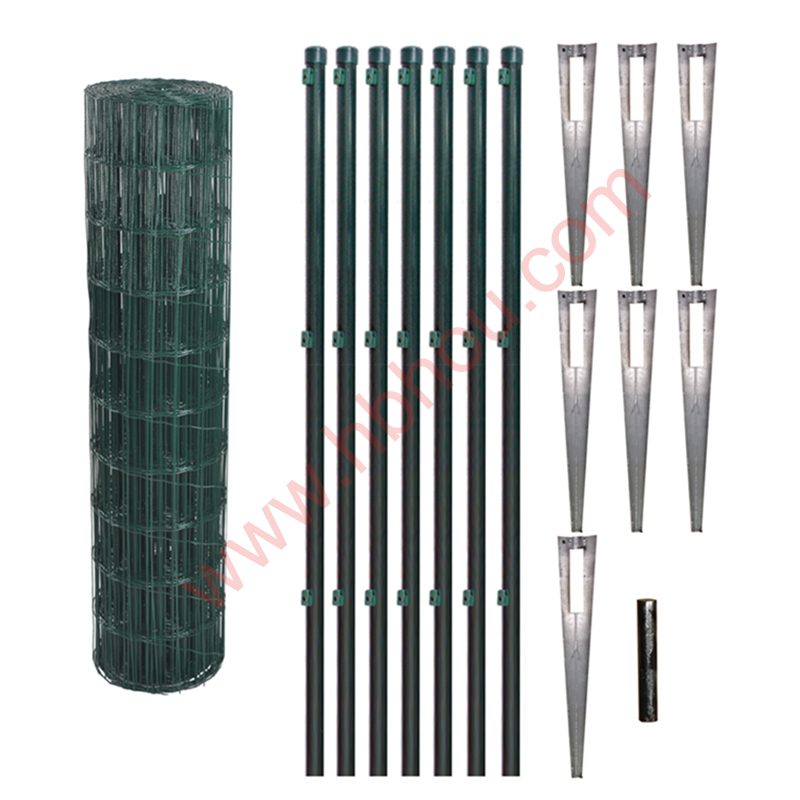
A fence is only as strong as its anchorage. The transition from temporary to permanent fencing depends on the installation method. Traditional burying methods involve inserting posts 50cm into the ground, maintaining a 2.5-meter internal distance between Euro posts. This creates a stable foundation that prevents leaning over time. For users who cannot dig into the substrate, spike anchor systems provide a high-efficiency alternative, allowing the fence to be hammered directly into the earth using a specialized hitting tool.
The tensioning mechanism is where the engineering value lies. By utilizing tension bars, binding wires, and tensioners, the wire mesh is kept taut across the horizontal plane. This prevents sagging and ensures that the boundary remains an effective deterrent. The addition of aluminum caps on the brace posts not only protects the tube ends from water ingress but also provides a professional, finished look to the entire installation.
Diverse Application Scenarios from Residential to Industrial Use
The versatility of chain-link and decorative panel systems allows them to be deployed across various sectors. In residential settings, they are ideal for garden patios and yard isolation, where the goal is to keep pets and children safe without completely blocking light. In the public sector, these systems are widely used for sports grounds and park perimeters due to their ability to withstand high-impact forces from balls or equipment.
Industrial applications require a higher security tier. For railways and highways, these fences serve as critical safety barriers. To upgrade the security level, manufacturers often integrate barbed wire or razor wire concertina coils. These additions stop intruders by creating a physical and psychological barrier, making the system suitable for high-risk border zones or temporary construction site enclosures where maximum security is mandatory.
Technical Specification and Component Comparison
| Treatment Type | Available Height | Post Material | Recommended Use |
|---|---|---|---|
| PVC Coated | 0.8m - 1.8m | Powder Coated Tube | Residential Gardens |
| Hot Dipped Galvanized | 0.8m - 1.5m | Galvanized Tube | Industrial Perimeters |
| Powder Coated | 0.8m - 1.8m | Powder Coated Tube | Urban Landscaping |
| Galvanized + Razor Wire | Custom | Heavy Duty Steel | Maximum Security |
| Eco-Friendly PVC | 0.8m - 1.5m | Galvanized Tube | Public Parks/Zoos |
Procurement Considerations for Budget-Friendly Fencing
When evaluating suppliers for perimeter solutions, procurement managers should look beyond the initial price per meter. A truly budget-friendly option is one that minimizes "Total Cost of Ownership" (TCO). This includes the cost of shipping, the ease of installation, and the frequency of maintenance. For e-commerce and online sales, packaging plays a critical role; high-tensile quality cartons prevent breakage during courier transit, reducing the cost of replacements.
Customization capabilities are another key factor. The ability to order sets that include posts, tensioners, and anchors in a single package reduces the risk of missing components during setup. A professional supplier provides complete kits, ensuring that the binding wires and aluminum caps match the specifications of the fence fabric, which streamlines the project timeline and ensures a uniform appearance across the entire boundary.
Future Trends in Metal Boundary and Garden Hardware
The industry is shifting toward "Humane and Simple" design philosophies. Modern gardening products are moving away from overly complex installations toward modular "plug-and-play" systems. The integration of anchor systems that require no digging is a prime example of this trend, catering to the growing DIY market and the demand for temporary but sturdy fencing in urban environments.
Additionally, there is an increasing demand for sustainable coatings that reduce environmental impact without sacrificing durability. The evolution of powder coating technology allows for thinner, more resilient layers that provide the same level of protection as traditional PVC but with better adhesion and a smaller carbon footprint during the manufacturing process.
Common Inquiries Regarding Metal Fencing Systems
What is the difference between PVC coated and hot-dipped galvanized fences?
Hot-dipped galvanization involves dipping steel into molten zinc for deep corrosion protection. PVC coating adds a plastic layer over the metal, providing color options and an extra shield against the elements, often used for aesthetic residential purposes.
Can these fences be installed without digging holes?
Yes, by using a spike anchor system. You can hammer the anchors directly into the ground using a hitting tool, which eliminates the need for digging and concrete pouring, making it ideal for temporary or fast-deployment projects.
Which fence height is recommended for garden privacy?
Depending on the requirement, heights range from 0.8m to 1.8m. For standard garden isolation and pet safety, 1.2m to 1.5m is common, while 1.8m is preferred for higher security or privacy boundaries.
How do I prevent the chain link mesh from sagging?
Sagging is prevented by installing tension wires horizontally through the fence knuckles and securing them with wire tensioners and tension bars at both ends of the fence line.
Are these products suitable for coastal areas with high salt spray?
Yes, specifically the hot-dipped galvanized options. The thick zinc layer provides the necessary protection against saline corrosion, though adding a PVC coating can further extend the lifespan in extreme maritime conditions.
What components are included in a complete fence set?
A typical set includes the fence roll, Euro posts, brace posts, tensioners, tension bars, tension wires, binding wires, aluminum caps, and optionally, spike anchors and a hitting tool.
Technical Industry References
- ASTM International - Standards for Steel Fencing
- ISO Standards for Corrosion Protection of Steel
- International Zinc Association - Galvanizing Guides
- PVC Industry Guidelines for Outdoor Coatings
Selecting a perimeter solution requires a careful analysis of environmental factors and security needs. By focusing on material quality and structural logic, you can ensure a long-lasting boundary that provides safety without excessive maintenance.
Related Industry Insights